
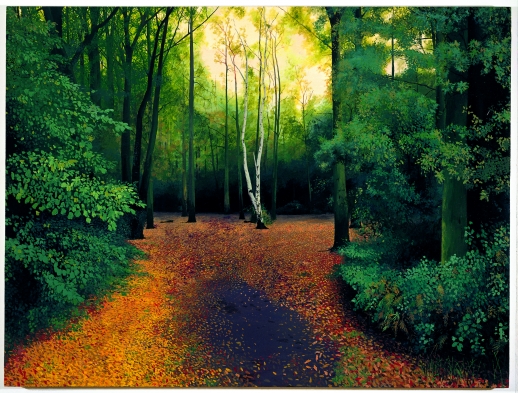
I went to see the George Shaw exhibition at the Baltic in Gateshead three times in 2011 and then attended a talk he gave at the same venue. His paintings are interesting on many different levels. They deal with universal concerns – memory, time passing – and yet are rooted in a very specific, everyday subject matter. He paints from photographs he has taken of the estate where he grew up – Tile Hill – on the outskirts of Coventry.Tile Hill is one of the many modern estates built in the 1960s to replace the kind of terraced streets I was born in. They were conceived after the Second World War in the spirit of Modernist town planning as an optimistic commitment to a better future. Having left home for higher education, Shaw eventually returned to photograph and paint the streets and woodland paths of his youth. The effect is strangely moving. What you see is a place which is growing old, being reclaimed by the natural world it was placed in. There is an air of death and decay. In a way you feel sorry for the place as you would for an ageing relative. In fact what you are feeling sorry for is yourself, your lost youth, the passing of time, the approach of death. The title of the exhibition supports this feeling. “The sly and unseen day” is a quote from Hardy and refers to the day of your death. The estate is a poignant metaphor for a person’s life. Like us, these estates were conceived in a spirit of hope and started life fresh, bright-eyed, looking to the future, but in old age we might ask what did we achieve, did we really fulfill those dreams? Places have a shelf-life just like us. The streets of my youth are no longer there.The history of Utopian planning schemes goes back a long way. Near where I lived in the centre of Leeds was Quarry Hill a large block of flats built in the 1930’s to great acclaim as self-contained urban environment. That too was demolished many years ago.
Shaw’s work also relates to themes found in the wider artistic world of literature. When talking about his paintings Shaw refers to Elliott, Larkin, Hardy etc. The titles of his works have a literary air about them. So I don’t think it is too far-fetched to see links in his work with writers’ themes – even if they were not specifically intended. A comparison with Proust for example seems apt. It isn’t just because Proust’s subject matter was the process of remembering the past. There is a more specific link than that. Proust saw his chilhood in terms of the paths around his childhood home. In fact he names each of his novels after one of these pathways – Swann’s Way, Guermantes Way etc – each of them leading to a different part of his memory. Shaw’s paintings show many routes round his home – steps. underpasses, gaps through hedges, actual paths through woodland. He uses them the same way Proust did – remembering those paths brings the past to life.
Finally the images themselves are striking, beautiful even. Unusually they are painted using enamel paint as bought in a hardware shop. They are at times almost photo-realist but have a an ethereal quality about them. The paint has a solidity and a sheen which seems both real and suggestive. The literary connection which comes to my mind is again French. Baudelaire was one of the first artists to describe the urban world , giving it the same respect as the natural one. He saw meaning and beauty in the everday. He called his works ” Les fleurs du mal” and any one since who sees truth and beauty in concrete,iron and tarmac owes a debt to the poet who believed that what most people reject as ugly can produce “flowers”.
The post-show talk with Shaw was not long enough. In fact only three questions were taken from the audience. This was a shame. The reason why Shaw’s exhibition has impressed me so much is that it opens up so many thoughts and questions which I can relate to. It came just at the the time when I was looking back at the Leeds I barely knew as a child and at an age when you can’t fail to think at times of “The sly and unseen day”.


 my chautauqua