A moveable table

Paris is, amongst many other things, a literary city. It features in the work of many great writers. Between the two World Wars, because of its relative cheapness and prohibition in the US, many Americans came to stay, write, eat and drink. One such, of course, was Ernest Hemingway, bon viveur if ever there was one. He told of his life in Paris in “A moveable feast”. A lot of the Paris he portrays no longer exists. He describes, for example, watching a neighbour going downstairs to collect the morning milk. This was provided, not far from the Boulevard Saint-Michel, by a passing herd of goats led by a goatherd. There are however places which Hemingway frequented which remain the same. In this category is Brasserie Lipp, the traditional 19th century café/restaurant near the Boulevard Saint-Germain. I once had lunch there with my wife on the proceeds of a windfall which we decided to blow on a no-holds-barred trip to Paris. Because of its reputation we entered Lipp with trepidation. The decor is typical brasserie, all brass and mirrors. The waiters wear traditional white aprons and were, to be honest, somewhat intimidating. It was heaving. I began to relax, feeling we were not going to get a table. Then it happened. The realisation that this was a welcoming, friendly place. Someone signaled “two?”, a waiter appeared carrying above his head a small table which he proceeded to insert in a gap which he created by easing diners and their tables to one side. We were now sat in a long row of joined-up tables, like the top table at a wedding reception. Again I had been made aware that there is no deep snobbery to eating out in France. There may be a money barrier but if you get over that once in a while you will be treated the same as any other customer. The same as Ernest Hemingway in fact.

Rosebud

79E0D528-CB1B-4256-AB2F-3A72BB30EA0A

Orson Welles’ film “Citizen Kane” begins with Kane on his deathbed. As he expires he utters the word “rosebud”. It is only at the end of the film, after we have witnessed his ruthless rise to enormous wealth and power, that we find out that rosebud was the name of his favourite toy as a child, a simple wooden sledge. As he died, after a life of material success and glory, he chooses to think of a time of innocence and purity.
One evening in November 1787 a young French artillery officer, recently arrived from the provinces, decided to go to the galleries surrounding the Palais Royale in Paris. At that time the Palais Royale, in spite of its grand name, was an amalgam of contemporary shopping mall, amusement park and red light district. There, everything was for sale. The officer found what he was looking for, and escorted the young girl back to his lodgings. Afterwards he wrote about the evening in a notebook. What is clear from his words is that the event was more than a transaction. The young woman deeply impressed him. Less than 15 years later he became Emperor of France. He had 20 years of unparalleled fame, wealth and glory. When Napoleon Bonaparte died in 1821 the notebook was found among his belongings. Throughout his rise to power Bonaparte had kept and protected the account of his naive and nervous first sexual experience. The night at the Palais Royale was Napoleon’s “rosebud” moment. Is it going too far to speculate that had Welles made a film of Napoleon’s life, it would have started with him on his deathbed on St Helena uttering the words “Palais Royale”?

The Literary Dolly Zoom

Films and books have different qualities and different purposes. Sometimes however, with certain authors, books can compete with films on the same terms. Cormac McCarthy’s style, for example, can be described as cinematic. There is a passage in chapter 4 of “Blood Meridian” which is quite simply breathtaking. It describes a massacre. It is filmic in the way it portrays the event from the victims’ point of view. It starts with what in a film would be called a long shot:- “The following day on the skyline to the south they saw clouds of dust that lay across the earth for miles.” The troop of soldiers watch a herd of cattle and horses approach, unconcerned. You can imagine the film soundtrack as the herd speeds up and becomes noisier, a little more threatening:- “The ponies had begun to veer off from the herd and the drovers were beating their way toward this armed company” There then follows what I can only describe as the most astounding sentence I have ever read. It is about 250 words long. The sentence doesn’t just describe the Indian charge but replicates it. The words themselves stampede forward. As a reader you hold your breath and feel the horror of the transfixed victims:- “A legion of horribles, hundreds in number, half naked or clad in costumes attic or biblical or wardrobed out of a fevered dream with the skins of animals and silk finery and pieces of uniform still tracked with the blood of former owners ….. one in a stovepipe hat and one with an umbrella and one in white stockings and a bloodstained weddingveil …. all howling in a barborous tongue and riding down on them like a horde from hell”. The camera is now in amongst the riders. Suddenly we get a close-up of the sergeant’s face, represented by one short sentence, as he realises his fate:- “Oh my god, said the sergeant.” 6 words. It’s as if the 250 word charge has come to a juddering stop. 6 words that seem as powerless as the soldiers facing the horde of riders. A great example of style matching content.

The whole two-page “tour de force” reminds me of the beach scene in Jaws, when the shark attacks. Here also the threat builds slowly through the use of the famous soundtrack, from long shot of the beach, through closer shots of the swimmers to the close-up of the police chief’s face as he realises the seriousness of the danger. The same psychological impact is achieved in both book and film. In Jaws the technique used is the dolly zoom shot, in which the camera moves in at a speed synchronised with the lens zooming out. The result is that the background telescopes away from the camera and the effect suggests the sudden psychological disorientation of the subject. In the book, the sudden short sentence zooms in on the victim’s face in a similar way. Those six words are in effect a literary dolly zoom shot. Even before the Indians reach their victims, McCarthy’s book has generated as much tension and drama as any film.

New Hartley Pit Disaster

51B716AF-8AE3-4358-A10D-3A996270E54E
South Northumberland, where I live is – or was – pit country. Most of the villages had a pit, some 2 or 3. They all had more than one shaft. The reason? Because of legislation relating to the New Hartley Pit Disaster of 1862 when around 200 miners died after being trapped in a one-shaft mine when the 40 tonne cast iron pump beam snapped and collapsed into the mine. The death toll was so high because it happened as the shifts were changing over. When they were found it was clear they had tried to dig themselves out but had finally had to give up. Fathers were found lying side by side with sons. The funeral cortège with the 200 coffins stretched for 4 miles.
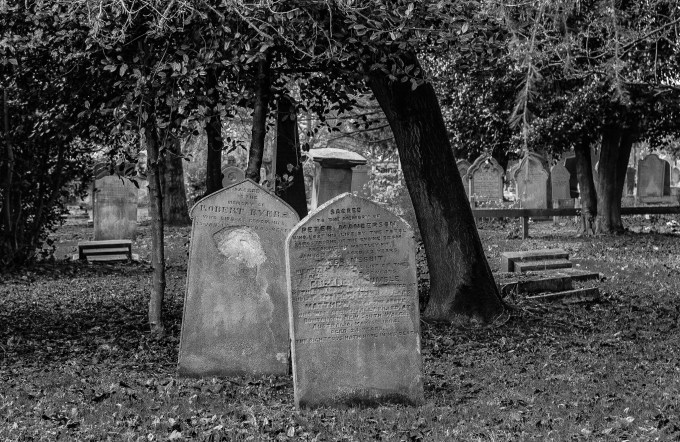
There is a church and graveyard opposite where I live in Cramlington – about 5 miles from New Hartley. I was out the other day trying out a new camera, photographing the church and gravestones.. Because they have inscriptions on them it’s a good test of sharpness. Later I enlarged the photos and found one with a very weathered inscription with 2 names on it, Peter Manderson and Peter Nesbit. The rest was illegible apart from one bit which said ” who lost his life by the fatal catastrophe of the engine beam breaking at Hartley pit”. When I checked, the records confirmed that they were among the fatalities. Nesbit was Manderson’s nephew. I guess they were found side by side.
I wasn’t keen on history at school. It only comes alive when you have a link with the past in front of you. I pass that gravestone every day. I’ve known of the New Hartley pit disaster for a while. It means something now..