Biff and Oscar Wilde’s Lost Sock

4D88F6D3-EF61-4D5F-9ED4-0D76D2B980BE

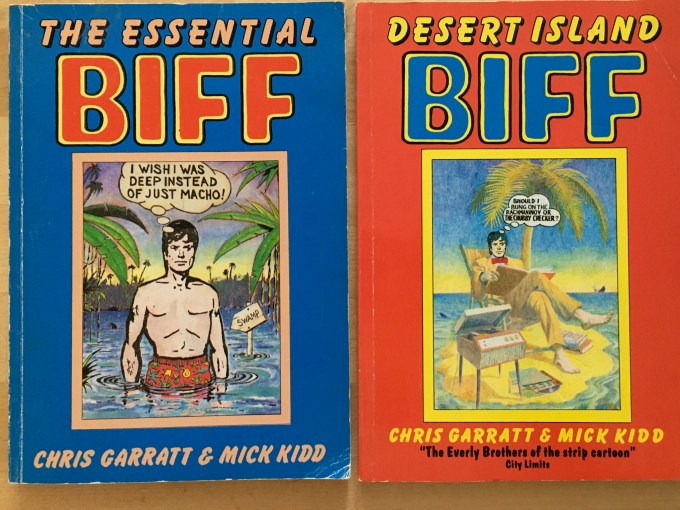
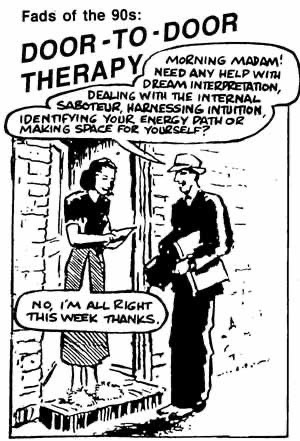
Biff is a British cartoon strip created by Chris Garrett and Mick Kidd in the 1980s. Its humour deflates pretentiousness by placing it in an everyday setting. Melodramatic, self-regarding, would-be poets are brought down to earth by ordinary people. Or pompous language is deflated by a non-sequitur
FC211546-FD73-4718-8F45-47530EC2326B

The cartoons are funny but they have a ring of truth. When I read them I know I’m laughing at myself. Oscar Wilde would have appreciated them. He tells a story of once going down to the Seine and, in true Romantic poet style, thinking of jumping in. On a bridge he saw another man looking down into the river. “Are you also a candidate for suicide?” Wilde asked. “No, I’m a hairdresser” came the reply. The comical non- sequitur so cheered Wilde up that he changed his mind.

In one cartoon a 1950s style teenager despairs with the words “I feel like a lost sock in the laundromat of oblivion”. With my slight adjustment to the boys name his girlfriend asks “Is it Angst, Oscar. Or is it just the lager?”


Irony and Ideology

98325CA0-A5C4-4A35-97DB-B438429AEEAC

Do ideologues understand irony? I doubt it. Not the verbal kind at least. When the words you use express the opposite of the literal meaning. People of conviction don’t mince their words. That’s why you should mistrust ideologues. People who don’t question themselves are blinkered and dangerous.

When Austria became part of the Third Reich in 1938 Sigmund Freud knew it was time to leave Vienna. Himmler was minded not to let him go to America but President Roosevelt arranged for him to get the necessary visa. When the Gestapo delivered it they asked him to sign a document to confirm he had been well treated. Freud did sign but added a sentence – “I can heartily recommend the Gestapo to anyone”. This was taken at face value. I like to imagine the Gestapo officers smugly leaving with the apparently glowing recommendation.

German scientists during WW2 were among the best in the world. They  designed the first jet fighter planes, the first guided missiles and came close to producing the first atomic bomb. But they never developed an irony detector.

Mi sofá es su sofá

I have a bone to pick with L P Hartley. Famously, the opening line of his novel The Go-Between reads “The past is a foreign country; they do things differently there”. He is emphasising what separates us from abroad and us from the past.

Consider these, however.

When Jean-Jacques Rousseau wrote Confessions in the late 18th century he introduced the public to a new kind of subject; himself, his thoughts, his feelings. Hundreds of readers, reclining on their chaises longues, showered him with fan mail.

Marcel Proust, the famous novelist and hypochondriac, loved music but hated going out. He resorted to inviting a string quartet to his house to play for him while he reclined on his green couch.

Gustave Flaubert was torn between his desire to travel and the comforting cocoon of his home. His friend Maxime du Camp complained that his friend would have liked to travel stretched out on a sofa, watching landscapes pass before him like the screen of a panorama mechanically unwinding.

What fun they would have had with modern technology. Flaubert with Google Street, Proust with Spotify, Rousseau’s public with Facebook. Surely they weren’t that different from us, were they?

The phrase “ mi casa es su casa” refers to a generosity of spirit that wants to share with other people. Sorry L P Hartley but I like the idea that people of the past shared similar needs and feelings with us today. As I recline at home with my smartphone I imagine myself reaching out with the words “ mi sofá es su sofá “.


The “Where are they now” trope

F1FC5FAA-E608-49D0-88B1-3C9058FF5049

The end credits of the comedy film A Fish called Wanda include the final joke; we are informed that Kevin Kline’s evil character will go on to become minister for justice in South Africa. The writer John Cleese is making use of the now common “where are they now” trope popularised by George Lucas when he lists the fate of the characters at the end of American Graffiti.

The trope depends on irony. So I was not surprised to discover that the trope was employed by the master of irony, Gustave Flaubert. In a novel. More than 100 years before those two films.

Madame Bovary, published in 1856, has a kind of end credit. An ironic one intended to make us smile at, and despair over, the state of bourgeois France, represented by the ignorant, incompetent Monsieur Homais.

The final sentence translates as – “ He has just received the Legion of Honour”