
One of my favourite football stories concerns the 1997 Cup Final. And it’s not really about one of the players. Di Matteo was in the Chelsea team. He has a sister, Concetta, who is blind. This does not stop her going to matches, however. Someone accompanies her and describes the game to her. I would love to hear a recording of that commentary when at the kick-off Concetta’s brother latched on to a pass and scored a screamer high up in the net after only 54 seconds. Her reward for overcoming adversity.
Author: dwells12014
Semi-retired ex High School French and German teacher now doing home tuition. I live in north-east England in Northumberland near Newcastle-on-Tyne about 100 miles south of the Scottish border.
In my life
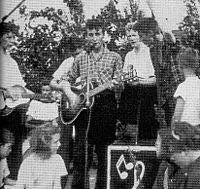
A rebel at school, a member of a Liverpool skiffle group who went on to become a multi- millionaire, touring America with his band. John Lennon? No, actually, I’m thinking of his best mate at school, Pete Shotton who died recently aged 76. He’s the blond one behind Lennon in the above photo of the Quarrymen, the skiffle band formed by Lennon in the late 1950s.
It’s arguable who had the most interesting life, Lennon or Shotton. Shotton left the Quarrymen when McCartney and Harrison joined but Lennon never forgot him. Several times, after hitting the big time, Lennon gave Shotton money. Shotton used it to open a supermarket then bought the franchise for a chain of American-style diners called Fatty Arbuckle. He eventually sold them for £20 million. When the Beatles needed someone to help run their Apple boutique in London they sent for Shotton. When it closed he became Lennon’s P.A. (until Yoko arrived). In the 90s, on the anniversary of the Cavern, the Quarrymen were reformed and Shotton appeared with them at Beatles conventions around the world.
Lennon and Shotton, two kids larking about in Liverpool. Two exciting but different lives, one a full life, the other cut short. Lennon was 40 when he was murdered in New York. You don’t have to be famous to live well. And fame doesn’t always mean an easy life.
“Though I know I’ll never lose affection / For people and things that went before / I know I’ll always stop and think about them” (In my life – John Lennon)
A moveable table


Paris is, amongst many other things, a literary city. It features in the work of many great writers. Between the two World Wars, because of its relative cheapness and prohibition in the US, many Americans came to stay, write, eat and drink. One such, of course, was Ernest Hemingway, bon viveur if ever there was one. He told of his life in Paris in “A moveable feast”. A lot of the Paris he portrays no longer exists. He describes, for example, watching a neighbour going downstairs to collect the morning milk. This was provided, not far from the Boulevard Saint-Michel, by a passing herd of goats led by a goatherd. There are however places which Hemingway frequented which remain the same. In this category is Brasserie Lipp, the traditional 19th century café/restaurant near the Boulevard Saint-Germain. I once had lunch there with my wife on the proceeds of a windfall which we decided to blow on a no-holds-barred trip to Paris. Because of its reputation we entered Lipp with trepidation. The decor is typical brasserie, all brass and mirrors. The waiters wear traditional white aprons and were, to be honest, somewhat intimidating. It was heaving. I began to relax, feeling we were not going to get a table. Then it happened. The realisation that this was a welcoming, friendly place. Someone signaled “two?”, a waiter appeared carrying above his head a small table which he proceeded to insert in a gap which he created by easing diners and their tables to one side. We were now sat in a long row of joined-up tables, like the top table at a wedding reception. Again I had been made aware that there is no deep snobbery to eating out in France. There may be a money barrier but if you get over that once in a while you will be treated the same as any other customer. The same as Ernest Hemingway in fact.
Rosebud

Orson Welles’ film “Citizen Kane” begins with Kane on his deathbed. As he expires he utters the word “rosebud”. It is only at the end of the film, after we have witnessed his ruthless rise to enormous wealth and power, that we find out that rosebud was the name of his favourite toy as a child, a simple wooden sledge. As he died, after a life of material success and glory, he chooses to think of a time of innocence and purity.
One evening in November 1787 a young French artillery officer, recently arrived from the provinces, decided to go to the galleries surrounding the Palais Royale in Paris. At that time the Palais Royale, in spite of its grand name, was an amalgam of contemporary shopping mall, amusement park and red light district. There, everything was for sale. The officer found what he was looking for, and escorted the young girl back to his lodgings. Afterwards he wrote about the evening in a notebook. What is clear from his words is that the event was more than a transaction. The young woman deeply impressed him. Less than 15 years later he became Emperor of France. He had 20 years of unparalleled fame, wealth and glory. When Napoleon Bonaparte died in 1821 the notebook was found among his belongings. Throughout his rise to power Bonaparte had kept and protected the account of his naive and nervous first sexual experience. The night at the Palais Royale was Napoleon’s “rosebud” moment. Is it going too far to speculate that had Welles made a film of Napoleon’s life, it would have started with him on his deathbed on St Helena uttering the words “Palais Royale”?
The Literary Dolly Zoom


Films and books have different qualities and different purposes. Sometimes however, with certain authors, books can compete with films on the same terms. Cormac McCarthy’s style, for example, can be described as cinematic. There is a passage in chapter 4 of “Blood Meridian” which is quite simply breathtaking. It describes a massacre. It is filmic in the way it portrays the event from the victims’ point of view. It starts with what in a film would be called a long shot:- “The following day on the skyline to the south they saw clouds of dust that lay across the earth for miles.” The troop of soldiers watch a herd of cattle and horses approach, unconcerned. You can imagine the film soundtrack as the herd speeds up and becomes noisier, a little more threatening:- “The ponies had begun to veer off from the herd and the drovers were beating their way toward this armed company” There then follows what I can only describe as the most astounding sentence I have ever read. It is about 250 words long. The sentence doesn’t just describe the Indian charge but replicates it. The words themselves stampede forward. As a reader you hold your breath and feel the horror of the transfixed victims:- “A legion of horribles, hundreds in number, half naked or clad in costumes attic or biblical or wardrobed out of a fevered dream with the skins of animals and silk finery and pieces of uniform still tracked with the blood of former owners ….. one in a stovepipe hat and one with an umbrella and one in white stockings and a bloodstained weddingveil …. all howling in a barborous tongue and riding down on them like a horde from hell”. The camera is now in amongst the riders. Suddenly we get a close-up of the sergeant’s face, represented by one short sentence, as he realises his fate:- “Oh my god, said the sergeant.” 6 words. It’s as if the 250 word charge has come to a juddering stop. 6 words that seem as powerless as the soldiers facing the horde of riders. A great example of style matching content.
The whole two-page “tour de force” reminds me of the beach scene in Jaws, when the shark attacks. Here also the threat builds slowly through the use of the famous soundtrack, from long shot of the beach, through closer shots of the swimmers to the close-up of the police chief’s face as he realises the seriousness of the danger. The same psychological impact is achieved in both book and film. In Jaws the technique used is the dolly zoom shot, in which the camera moves in at a speed synchronised with the lens zooming out. The result is that the background telescopes away from the camera and the effect suggests the sudden psychological disorientation of the subject. In the book, the sudden short sentence zooms in on the victim’s face in a similar way. Those six words are in effect a literary dolly zoom shot. Even before the Indians reach their victims, McCarthy’s book has generated as much tension and drama as any film.
New Hartley Pit Disaster
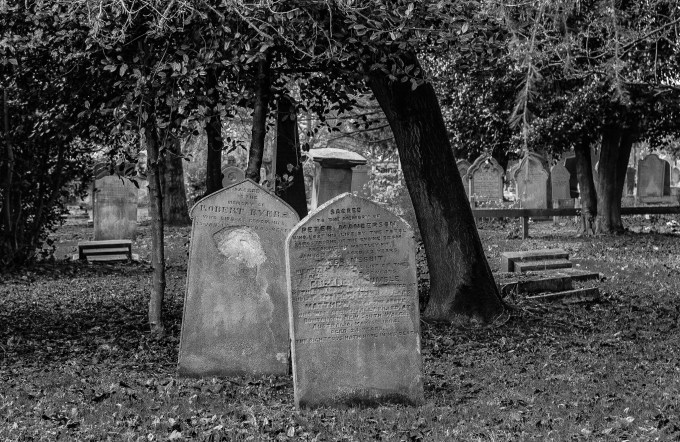
South Northumberland, where I live is – or was – pit country. Most of the villages had a pit, some 2 or 3. They all had more than one shaft. The reason? Because of legislation relating to the New Hartley Pit Disaster of 1862 when around 200 miners died after being trapped in a one-shaft mine when the 40 tonne cast iron pump beam snapped and collapsed into the mine. The death toll was so high because it happened as the shifts were changing over. When they were found it was clear they had tried to dig themselves out but had finally had to give up. Fathers were found lying side by side with sons. The funeral cortège with the 200 coffins stretched for 4 miles.
There is a church and graveyard opposite where I live in Cramlington – about 5 miles from New Hartley. I was out the other day trying out a new camera, photographing the church and gravestones.. Because they have inscriptions on them it’s a good test of sharpness. Later I enlarged the photos and found one with a very weathered inscription with 2 names on it, Peter Manderson and Peter Nesbit. The rest was illegible apart from one bit which said ” who lost his life by the fatal catastrophe of the engine beam breaking at Hartley pit”. When I checked, the records confirmed that they were among the fatalities. Nesbit was Manderson’s nephew. I guess they were found side by side.
I wasn’t keen on history at school. It only comes alive when you have a link with the past in front of you. I pass that gravestone every day. I’ve known of the New Hartley pit disaster for a while. It means something now..
A dog and a toilet*

My school had a film club. Early 1960s so it involved a 35mm reel-to-reel projector, which meant the film had to be rewound at the end to be ready for the next showing. One time, when the lights dimmed we found ourselves watching Tom Courtney running backwards down a country lane. At a stroke, by forgetting to rewind the film, our teacher had transformed “The Loneliness of the Long Distance Runner” into a Surrealist film.
The Surrealists had a variety of ways of removing rationality from the experience of viewing a film. Sometimes – perhaps when the recreational drugs had run out – they would spend the evening in Paris running from cinema to cinema watching random snatches of several different films – the film equivalent of Chinese Whispers. To randomise the experience even more they would wave their hands in front of their eyes as they watched.
I’ve always thought the Surrealists could have saved themselves a lot of effort by joining my school’s film club.
* ( A dog and a toilet? That was how my friend referred to Luis Buñuel’s Surrealist masterpiece “Un chien Andalou” )
Ensign Ewart
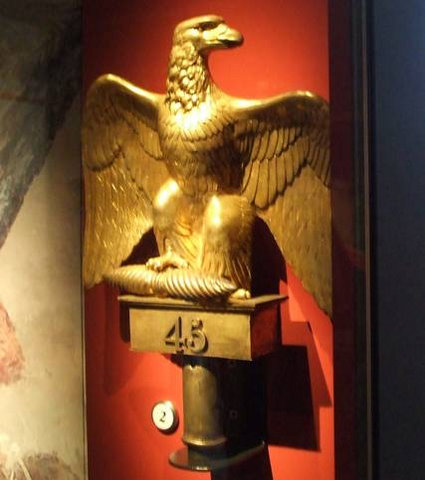
Wellington called his army “the scum of the earth”. And that is how they were treated. They either died in battle or returned home to poverty and died in obscurity. This is the story of one soldier in Wellington’s army who avoided all three fates. It was the equivalent of winning the lottery three times.
On the 18th June 1815 Charles Ewart was sitting on his horse on a ridge in Belgium, alongside his fellow dragoons of the Scot’s Greys, about to take part in the battle of Waterloo. Soon after they charged towards the French infantry Ewart spotted a rare and valuable prize – one of Napoleon’s standards which had been specially made with a solid gold eagle’s head on the top. Ewart killed three standard bearers to capture it. He was about to rejoin the battle when he had his first stroke of luck. One of his generals ordered him to take the prize back to the ridge. From there he watched as the charge faltered and many of his brigade lost their lives.
It took several weeks before the army returned home. In that time, through newspaper coverage, Ewart became famous. And so came about his second piece of luck. The army returned to a country in recession and a government who thanked its army by cutting their numbers hugely. Many soldiers, with no jobs to return to, became destitute and took to begging in the streets. Ewart, however, as he sat on the dock at Calais, was spotted and recognised by a friend of the Duke of York. He asked Ewart what he most wanted in life. Ewart replied that if he could become an Ensign in a veteran battalion he could retire on an officer’s pension. On the spot he was given a letter of recommendation which granted Ewart his wishes.
Ewart died in 1846 and was buried in Manchester. Twice in his life he had escaped oblivion. He managed it again even in death. The church where he was buried fell into disuse and the graveyard covered over. He remained without a memorial for 80 years. Then, in the 1920s a historian of the Scot’s Greys spent 12 years trying to find his grave. When he did, he arranged for his remains to be buried at the ancestral home of the Greys – Edinburgh castle. As you walk on the Esplanade towards the castle, high on a ridge above the town, there is now a large memorial to his name. Fitting. From a ridge in Belgium to a ridge in Scotland. Ensign Ewart, the man who cheated fate three times.

I guess it’s time for a school huddle

News travels fast. Well it does now because of social media. It travelled a bit more slowly when I was young. In the absence of a landline phone at home, if you wanted to contact someone, you walked to their house and knocked on the door.
When the news was big there was another key channel for news-spreading – the huddle at school. In the half-hour before the school doors opened groups of friends would gather, form a huddle and it was all “did you see …… on tv last night?”
I specifically remember two morning huddles. The first was in 1960 when the rumour spread that someone had brought the first unexpurgated copy of Lady Chatterly’s Lover into school. It was true; we just needed to know who it was and how we could get a look.
The other was in 1962 and was truly scary. One October morning we huddled because we were convinced nuclear war was about to be declared. The Soviet Union and the US were squaring up over the Cuban Missile Crisis and President Kennedy had set a deadline.
The Soviets backed down and since then we have consoled ourselves with the the thought that the balance of power would continue to protect us from nuclear war. Circumstances have changed though. Two days ago the members of the Bulletin of Atomic Scientists acknowledged this fact by moving the time on their Domesday Clock 30 seconds closer to midnight. Why? Because the idea of a balance of power no longer rings true. The threat now comes from “rogue” leaders, be they North Korean or North American. Or terrorist. One thing I’m sure of, however, is that if someone like Trump had come to power in the 1960s it would have been huddle time at school.
The colour of vowels
” A black, E white, I red, U green, O blue – vowels / One day I will recount your latent births.” VOYELLES Arthur Rimbaud


When I think of the days of the week, in my mind’s eye I see some of them as shapes and colours. Saturday is a red upright rectangle, Sunday a white oval. Wednesday is also an oval, but yellow, whereas Monday is orange but shapeless. The other days of the week have neither shape nor colour. The proper name for this crossing-over of the senses is, of course, synaesthesia. Mine is limited to just four of the days of the week, but in certain people it can be much more pronounced. Not much to shout about, perhaps, but at one time, in the world of the arts, it was a hot topic.
Rimbaud wrote a poem about it – “Voyelles” – in which letters themselves – the 5 vowels – summon up colours and sounds. He was sharing in a popular belief. Baudelaire’s poem “Correspondances” had earlier talked of “perfumes as cool to the touch as children’s flesh”. Rimbaud had a friend, Ernest Cabaner, who taught the piano by sticking pieces of coloured paper on the piano keys, because he believed each note of the octave corresponded to a particular vowel and colour. Rimbaud himself wrote that he imagined a future “universal language” that could be understood by all the senses at once.
The importance of the idea of synaesthesia in the late 19th century was bound up with a general belief in the interconnectivity of all the arts. The art form many avant-guard artists aspired to was music, seen as the purest, most abstract of all the arts, since there was no requirement for it to represent the real world. Language, colours and sound were seen to be coming together. Critics appreciated the musical qualities of poetry, not just its meaning. The formal elements of visual art began to be described as a language. Where poetry had led, painting followed. In the 1880s and 90s, post-impressionist painters began to use colour expressively, rather than as a way of representing objective reality.If Matisse or Gauguin wanted a face to be green, then green it became. If Rimbaud wanted a boat to be drunk, then drunk it was.
In effect poets and artists were liberating the formal elements of their medium – words and colours – from the requirement to correspond with the outside world. And so language and form begin to take on a life of their own. Rimbaud’s word-pictures are powerful and interesting in their own right without needing to be explained in relation to the real world. This is the same move towards abstraction that Matisse made in his paintings. Colour for him was synaesthetic – it had emotional power and could hold the painting together without the need to be realistic. This was the first necessary step on the road to abstract art. These days line, shape, texture and colour are sufficient to carry a whole painting.
Abstract art is an acquired taste. Not everyone likes it. I do. But then I would, wouldn’t I? I see Saturday as a red rectangle.
 my chautauqua