Baudelaire’s Phone Pic

“Rubbing the parched roadway with his webbed feet, he went trailing his white wings on the rough ground. Beside a dried-up gutter the poor creature, with gaping beak, was frantically bathing his wings in the dust, and with his heart full of longing for his native land, cried out….” (The Swan – Charles Baudelaire)


What would you fo if you saw a swan flapping helplessly on a building site. Presumably you’d try and help it. Also, probably, you might take a photo with your phone. Why would you do this? I think it would be to do with the incongruity of such a graceful bird in a concrete desert.
Charles Baudelaire did just that in Paris in the 1850s. Only of course, he didn’t take a photo; he wrote a poem – Le Cygne, perhaps his best known poem in the collection “Les Fleurs du Mal”. The swan had escaped from a menagerie near the Louvre and wandered onto the huge building site that was central Paris at that time as it was being transformed into the Paris we know today. With his Realist roots Baudelaire couldn’t fail to record what he saw.
But Baudelaire also wrote on the cusp of the Symbolist movement. The swan represented us, dislocated, alienated by the changing modern city. Huge numbers of prople were uprooted by the rebuilding of Paris and relocated to the suburbs, uprooted psychologically as well as physically. Soon sociologists would give this a name – anomie – the kind of alienation that leads to despair, something not unknown in the suburbs of Paris today.
But more than this, Baudelaire also saw a mysterious kind of beauty in the strange placing of a swan in the rubble – a flower, indeed, among the evil. It’s what modern urban photographers look for today, strange but eye-catching juxtapositions amongst the decay. But Baudelaire did it first. Over 150 years ago. Without a phone.

Art as yet unknown

Honoré de Balzac wrote Le Chef d’Oeuvre Inconnu (The Unknown Masterpiece) in 1831. In it an artist spends ten years creating what he thinks is his masterpiece. When he finally shows it to two young artists they stare at it, uncomprehending.
“Can you see anything?”
“No, can you?” “Nothing”. “All I can see are blocks of different colour in a confused mass bound by a multitude of weird lines which form a wall of paint”. The artist is horrified “Nothing! Nothing to show for ten years of work!”
In his book Balzac aims to show the futility of aiming for perfection but, 50 years before Post-Impressionism and nearly 100 years before abstract art, he unwittingly anticipates the bemused reaction to the work of artists such as Cézanne and, later, Mondrian, as shown in the photos above.
In the 1880s Cézanne made around 100 paintings of one mountain, le Mont Victoire in Provence. The subject matter was a pretext. He was trying to show the problem of painting a 3D subject on a 2D canvas, using “blocks of colour” and “mulitudes of lines”. Most viewers saw confusion and weirdness. In the 20th century, artists such as Mondrian were inspired by Cézanne to limit their works to the formal elements of line, colour and “walls of paint”. Balzac is usually categorised as a Realist, a mere recorder of everyday life. The trouble with categories is they are limiting and therefore often wrong. Balzac was also a visionary.

Proust: Lost in translation

I guess it’s not easy being a genius. People just don’t get what you’re about. Take Marcel Proust. You write a passage where someone dunks a madeleine and everyone, including critics, eulogise how sensory experience can evoke the past, a happy, romantic past. A link is made with the english translation of “À la recherche du temps perdu”, loosely translated as “In Search of Lost Time”. Times lost to our memory, now happily restored. Trouble is, “perdu” in French can mean “wasted” as well as “lost”. Proust isn’t merely telling us what we already know; that the smell of a new car can remind us of our first car. He is saying something deeper and more tragic. You waste your life by not appreciating it properly. The only time you do appreciate it is in memory – when it’s too late.

A Nation of Miserable Shopkeepers 

Napoleon Buonaparte once famously called England a nation of shopkeepers. He didn’t mean it as a compliment. There is evidence that maybe he was right. 

Victor Hugo published his great novel Les Misérables in 1862. In France it was a sensation, political dynamite. In England, however, at least one business saw it as a promotional opportunity. The “Sixpenny” 1887 English translation included a message on the inside cover – 

“What higher aim can man attain than conquest over human pain? Don’t be without a bottle of Eno’s Fruit Salt. 

Chateaubriand’s tomb

Gustave scrambled up the rocks which formed the perimeter of the island. He had been in good spirits as he had walked out to this small rock a hundred yards offshore at St Malo. At low tide the island jutted out from the expanse of gleaming, wet sand. When he reached the top he collapsed giggling on the grass. Another superb day on the three-month walking trip beckoned. 

   Gustave made an effort to compose himself. There it was. Chateaubriand’s tomb. It was empty of course. Chateaubriand had had it built 23 years earlier and thereby had unwittingly created a popular tourist site. Gustave lay back on the damp grass, closed his eyes and let his mind wander through the events of the great adventure.

   He had made a deliberate choice to start the trip by walking across Paris before taking the train to the Loire. There was an element of play-acting; he was a vagabond, a gypsy, happy and free. 

  His first stopping place on the Loire was the town of Blois. He spent the day climbing the narrow streets from the river to the castle at the top of the hill. It was Sunday; the houses were shuttered and the streets silent. There were literary associations everywhere. This was where Hugo had grown up as a boy and one of the places from which Balzac had drawn inspiration. 

   Gustave imagined the people sequestered behind the shutters. He began to focus in particular on what it must be like for a woman who may already be trapped in a loveless marriage; one who, like him, had read everyone’s Romantic hero, Chateaubriand. A book was forming in his mind. He had tried before, unsatisfactorily, to express his feelings about the disappearance of the Romantic promise of the turn of the century. How bourgeois reality had dashed those hopes and dreams.

  When Gustave opened his eyes and stood up on Chateaubriand’s rock he felt fully alive. Later he would remember returning to St Malo “animated, moved, almost furious”. As he walked slowly on the sand a name popped into Gustave’s mind.

He would call her Emma; Emma Bovary

Biff and Oscar Wilde’s Lost Sock

4D88F6D3-EF61-4D5F-9ED4-0D76D2B980BE

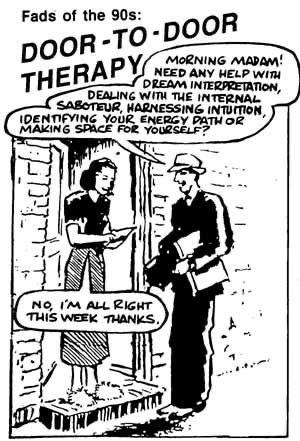
Biff is a British cartoon strip created by Chris Garrett and Mick Kidd in the 1980s. Its humour deflates pretentiousness by placing it in an everyday setting. Melodramatic, self-regarding, would-be poets are brought down to earth by ordinary people. Or pompous language is deflated by a non-sequitur

FC211546-FD73-4718-8F45-47530EC2326B

The cartoons are funny but they have a ring of truth. When I read them I know I’m laughing at myself. Oscar Wilde would have appreciated them. He tells a story of once going down to the Seine and, in true Romantic poet style, thinking of jumping in. On a bridge he saw another man looking down into the river. “Are you also a candidate for suicide?” Wilde asked. “No, I’m a hairdresser” came the reply. The comical non- sequitur so cheered Wilde up that he changed his mind.

In one cartoon a 1950s style teenager despairs with the words “I feel like a lost sock in the laundromat of oblivion”. With my slight adjustment to the boys name his girlfriend asks “Is it Angst, Oscar. Or is it just the lager?”


Mi sofá es su sofá

I have a bone to pick with L P Hartley. Famously, the opening line of his novel The Go-Between reads “The past is a foreign country; they do things differently there”. He is emphasising what separates us from abroad and us from the past.

Consider these, however.

When Jean-Jacques Rousseau wrote Confessions in the late 18th century he introduced the public to a new kind of subject; himself, his thoughts, his feelings. Hundreds of readers, reclining on their chaises longues, showered him with fan mail.

Marcel Proust, the famous novelist and hypochondriac, loved music but hated going out. He resorted to inviting a string quartet to his house to play for him while he reclined on his green couch.

Gustave Flaubert was torn between his desire to travel and the comforting cocoon of his home. His friend Maxime du Camp complained that his friend would have liked to travel stretched out on a sofa, watching landscapes pass before him like the screen of a panorama mechanically unwinding.

What fun they would have had with modern technology. Flaubert with Google Street, Proust with Spotify, Rousseau’s public with Facebook. Surely they weren’t that different from us, were they?

The phrase “ mi casa es su casa” refers to a generosity of spirit that wants to share with other people. Sorry L P Hartley but I like the idea that people of the past shared similar needs and feelings with us today. As I recline at home with my smartphone I imagine myself reaching out with the words “ mi sofá es su sofá “.


The “Where are they now” trope

F1FC5FAA-E608-49D0-88B1-3C9058FF5049

The end credits of the comedy film A Fish called Wanda include the final joke; we are informed that Kevin Kline’s evil character will go on to become minister for justice in South Africa. The writer John Cleese is making use of the now common “where are they now” trope popularised by George Lucas when he lists the fate of the characters at the end of American Graffiti.

The trope depends on irony. So I was not surprised to discover that the trope was employed by the master of irony, Gustave Flaubert. In a novel. More than 100 years before those two films.

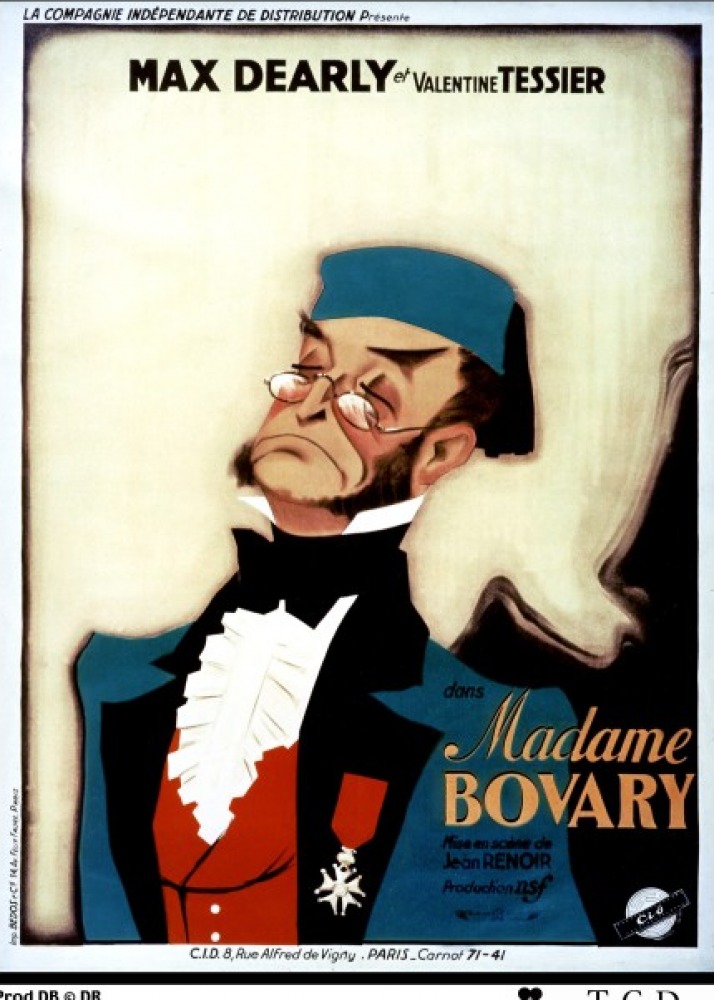
Madame Bovary, published in 1856, has a kind of end credit. An ironic one intended to make us smile at, and despair over, the state of bourgeois France, represented by the ignorant, incompetent Monsieur Homais.

The final sentence translates as – “ He has just received the Legion of Honour”

It was alright in the 1870s

There is a tv program called “It was alright in the 1970s”. It shows politically incorrect clips from 1970s tv programs to prove how attitudes have changed over the years, the idea being that those attitudes were normal then and so perhaps excusable. This, of course, is the argument made by several ageing celebrities today to excuse behaviour now seen as sexual harassment and abuse.
One of the problems this causes is how one should view the work of writers and artists with similar problematic pasts. The issue becomes even more difficult the further one goes back in time as behaviour and attitudes become even more remote from what is acceptable today.
Consider the case of Victor Hugo. By 1870 Hugo was 68 and one of the most famous men on the planet. He used this fame to attract and seduce huge numbers of women. During the five- month siege of Paris at the end of the Franco-Prussian war in 1871 Hugo had approximately  one sexual encounter per day, a total of 40 different partners. They were actresses, prostitutes, fans who came to see him.  We know this because he recorded them, in semi code, in his diary. He often changed their names into male equivalents and used code words to indicate the type of activity. He also recorded what he paid. Hugo was very careful with money. All his life he kept accurate accounts and so felt compelled to record his transactions with women. And here’s the point –  he clearly had a conscience about this. He recorded these payments  with the abbreviation “sec”, i.e. “secours” meaning alms. Hugo saw this as giving alms to the poor. He wanted to believe he was doing these women a favour. In his lifetime this amounted to hundreds, if not thousands, of favours. This is the man who appealed for our sympathy for the abused prostitute Fantine in Les Misérables.

Hugo had a wife and a long-standing mistress who he cheated on with another married woman – a ménage à quatre? The married woman’s husband had them investigated for adultery. She was imprisoned. Hugo was not. He was above the law because he was a French peer.
His diary also reveals that he viewed  his female servants and cooks as another source of sexual gratification. Their plight surely gives cause for concern. What choice did they have? Say yes or look for another job? What is the difference between their situation and that of Harvey Weinstein’s female employees? How many of Hugo’s conquests would have wished to be able to raise their hand and declare “Me too”? Should this influence our judgement of Victor Hugo and his work? Or do we simply shrug our shoulders and think it was alright in the 1870s?

When Charles met Fyodor


“Two souls live within me, each trying to pull away from the other” (Wolfgang Von Goethe)

When Charles Dickens met Fyodor Dostoevsky in 1862 two worlds collided. Two views of human nature. A traditional one and a modern, psychological one.
Whatever the undoubted merits of Dickens novels they are, for modern tastes, simplistic. Their characters have little, or no, psychological depth. They are either paragons of virtue, innocent victims such as Little Nell and Tiny Tim, or evil monsters such as Uriah Heep and Bill Sykes. This is perhaps surprising, since Dickens was well aware of the complicated nature of the human personality. He recognised it in himself. On the one hand he backed up his reputation as a morally upright person with many examples of selfless good works. But he knew he also had a dark side, a side to his character which he skilfully kept from his adoring public. He admitted as much to Dostoevsky. Dostoevsky later said that Dickens “told me that all the good simple people in his novels….. are what he wanted to have been, and his villains were what he was (or rather what he found within himself)”.
Dickens’ view of inner conflict was traditional in that he explained it in religious terms as a battle between Good and Evil. In characters such as Raskolnikov in Crime and Punishment Dostoevsky eschewed such simplistic notions and explored how conflict, anxiety and guilt worked. The claim that his novels prefigure the work of Sigmund Freud is not unjustified.
Dickens wouldn’t have known that of course, but Dostoevsky did give him a clue. When Dickens declared there were two people inside him, Dostoevsky replied “Only two?”

58A5F685-14BD-4923-8899-B41F31404147