In search of live music

26F7CE36-18C8-4DCF-B505-DF1E30061F2A

Marcel Proust was born in the wrong century. For a man who loved listening to music but who for periods of his life was reluctant to leave his bed, let alone his flat in Paris, getting himself to concerts was a chore. He tried two solutions to this problem. In 1911 he became a subscriber to Théâtrophone, a service that held a telephone receiver up at a concert and relayed it to people’s homes. Phones then, of course, had sound quality one step up from tin cans joined by a wire. It wasn’t that the reproduction was low-fi rather than hi-fi. It wasn’t even fi. What he really wanted was live music at home. And so it happened that one night in 1916 the French violinist and quartet leader, Gaston Poulet answered the doorbell at 11p.m. to find Marcel Proust on the doorstep. Proust had an unusual proposition. Would Poulet round up the rest of the quartet and come and play Cesar Franck’s String Quartet in D major that night at Proust’s flat? He had a taxi waiting. So that’s what they did. They played the piece in Proust’s candlelit bedroom while Marcel reclined on a green divan. It must have been good. When they finished at 2a.m. Proust asked them to play it again.

Proust was born about 100 years too early. Spotify would have been a godsend. But then again, if he’d lived in the era of video cameras and social media he might not have seen the point of recreating the past in written form. We don’t see the need to go In search of lost time. We carry it around with us.

The most beautiful walk in the world

IMG_0905

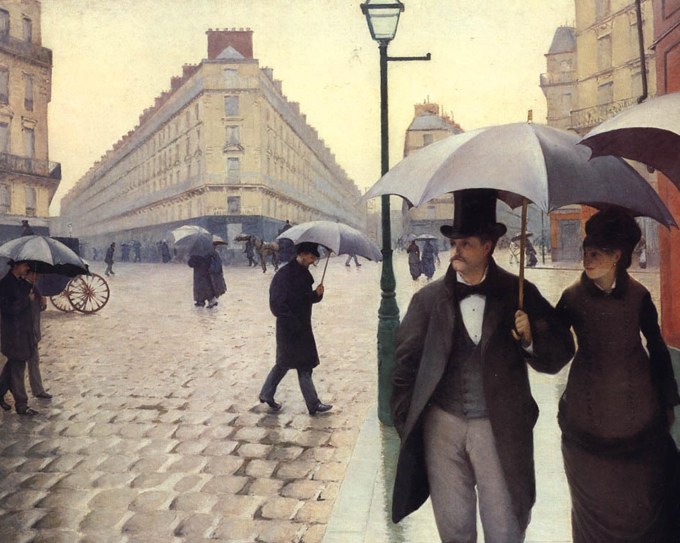
There is a book, written by John Baxter, called The most beautiful walk in the world. He’s not talking about an Alpine trail or a hike in the Scottish Highlands. He reckons it’s in Paris. And I would tend to agree. I much prefer walking round a town to hiking in the countryside. I don’t think it’s laziness; I did some strenuous fell walking as a young man. I just find more of interest to look at and photograph in the city. I’m impressed by spectacular views in nature but the wonder wears off. So I smiled when I found these quotes:-

“I like a good view, but I prefer to sit with my back to it” (Alice B. Toklas)

“Je suis incapable de m’attendrir sur les végétaux.” (I am incapable of being moved by vegetation) (Charles Baudelaire)

I suppose those words are not surprising coming from the flâneur Baudelaire. You just couldn’t see him with anorak, map and compass. Cognac and cigar, yes. Hiking boots, not really.

The Bash Street Kids

8C3F7232-2B0C-4E26-AF4F-4FF4236C2A5C

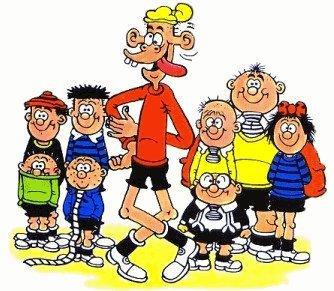
Leo Baxendale, the creator of the Bash Street Kids, died recently at the age of 86. When I was a paper boy I read every comic in the bag – Beano, Dandy, Topper, Beezer, Tiger, and more. I loved the names created by Baxendale. In the Bash Street Kids you found Smiffy, Spotty, Toots and, my favourite, Pug. Elsewhere he introduced us to Clever Dick, Grimley Feendish and the amazing Sweeney Toddler.
It’s a lost world and one I have a lot to be grateful for. My granddad Bill taught me to read before I started to go to school by reading comics to me. He used to walk up from work for lunch, sit me on his knee and introduce me to the Bash Street Kids. Thanks Bill, and thanks Leo.

Travelling Light

5CD3D0A3-1E0A-4A7F-903E-20ED046C0DAD

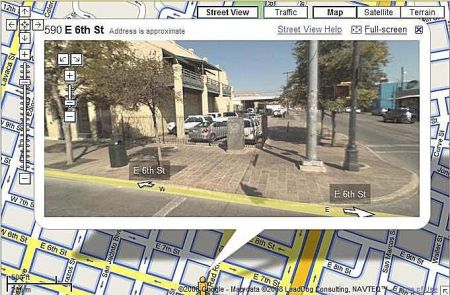
I have always thought that there was something wrong with me. Is it right that a person should get more pleasure from planning a holiday than going on it? Why have I got a clip- board containing the detailed plans of at least ten trips abroad that were never embarked on – mileage lists, fuel costings, hotel and campsite bookings (thank goodness for the “free cancellation” option), web searches on restaurants, places of interest. Google street is a godsend for someone like me. I have done so many virtual tours of St Remy in Provence that I feel there is little point in going there since I know it so well. Is it a sickness? And if so, is there a cure? But the more I read the more support I find for this admittedly minority point of view.
Here then, in my defence, are three quotations which give me comfort:-

Logan Pearsall Smith “People say that life is the thing, but I prefer reading”

Gustave Flaubert “Do not participate: happiness lies in the imagination not the act. Pleasure is found first in anticipation, later in memory”

Honoré de Balzac “How can one prefer the disasters of your frustrated desires to the sublime faculty of summoning the universe to appear before the mind’s eye”

They say travel broadens the mind. I agree, particularly if you only ever travel in your mind. Travelling light? You can’t travel any lighter than I do.

A moveable table

Paris is, amongst many other things, a literary city. It features in the work of many great writers. Between the two World Wars, because of its relative cheapness and prohibition in the US, many Americans came to stay, write, eat and drink. One such, of course, was Ernest Hemingway, bon viveur if ever there was one. He told of his life in Paris in “A moveable feast”. A lot of the Paris he portrays no longer exists. He describes, for example, watching a neighbour going downstairs to collect the morning milk. This was provided, not far from the Boulevard Saint-Michel, by a passing herd of goats led by a goatherd. There are however places which Hemingway frequented which remain the same. In this category is Brasserie Lipp, the traditional 19th century café/restaurant near the Boulevard Saint-Germain. I once had lunch there with my wife on the proceeds of a windfall which we decided to blow on a no-holds-barred trip to Paris. Because of its reputation we entered Lipp with trepidation. The decor is typical brasserie, all brass and mirrors. The waiters wear traditional white aprons and were, to be honest, somewhat intimidating. It was heaving. I began to relax, feeling we were not going to get a table. Then it happened. The realisation that this was a welcoming, friendly place. Someone signaled “two?”, a waiter appeared carrying above his head a small table which he proceeded to insert in a gap which he created by easing diners and their tables to one side. We were now sat in a long row of joined-up tables, like the top table at a wedding reception. Again I had been made aware that there is no deep snobbery to eating out in France. There may be a money barrier but if you get over that once in a while you will be treated the same as any other customer. The same as Ernest Hemingway in fact.

The Literary Dolly Zoom

Films and books have different qualities and different purposes. Sometimes however, with certain authors, books can compete with films on the same terms. Cormac McCarthy’s style, for example, can be described as cinematic. There is a passage in chapter 4 of “Blood Meridian” which is quite simply breathtaking. It describes a massacre. It is filmic in the way it portrays the event from the victims’ point of view. It starts with what in a film would be called a long shot:- “The following day on the skyline to the south they saw clouds of dust that lay across the earth for miles.” The troop of soldiers watch a herd of cattle and horses approach, unconcerned. You can imagine the film soundtrack as the herd speeds up and becomes noisier, a little more threatening:- “The ponies had begun to veer off from the herd and the drovers were beating their way toward this armed company” There then follows what I can only describe as the most astounding sentence I have ever read. It is about 250 words long. The sentence doesn’t just describe the Indian charge but replicates it. The words themselves stampede forward. As a reader you hold your breath and feel the horror of the transfixed victims:- “A legion of horribles, hundreds in number, half naked or clad in costumes attic or biblical or wardrobed out of a fevered dream with the skins of animals and silk finery and pieces of uniform still tracked with the blood of former owners ….. one in a stovepipe hat and one with an umbrella and one in white stockings and a bloodstained weddingveil …. all howling in a barborous tongue and riding down on them like a horde from hell”. The camera is now in amongst the riders. Suddenly we get a close-up of the sergeant’s face, represented by one short sentence, as he realises his fate:- “Oh my god, said the sergeant.” 6 words. It’s as if the 250 word charge has come to a juddering stop. 6 words that seem as powerless as the soldiers facing the horde of riders. A great example of style matching content.

The whole two-page “tour de force” reminds me of the beach scene in Jaws, when the shark attacks. Here also the threat builds slowly through the use of the famous soundtrack, from long shot of the beach, through closer shots of the swimmers to the close-up of the police chief’s face as he realises the seriousness of the danger. The same psychological impact is achieved in both book and film. In Jaws the technique used is the dolly zoom shot, in which the camera moves in at a speed synchronised with the lens zooming out. The result is that the background telescopes away from the camera and the effect suggests the sudden psychological disorientation of the subject. In the book, the sudden short sentence zooms in on the victim’s face in a similar way. Those six words are in effect a literary dolly zoom shot. Even before the Indians reach their victims, McCarthy’s book has generated as much tension and drama as any film.

The colour of vowels

” A black, E white, I red, U green, O blue – vowels / One day I will recount your latent births.” VOYELLES Arthur Rimbaud


When I think of the days of the week, in my mind’s eye I see some of them as shapes and colours. Saturday is a red upright rectangle, Sunday a white oval. Wednesday is also an oval, but yellow, whereas Monday is orange but shapeless. The other days of the week have neither shape nor colour. The proper name for this crossing-over of the senses is, of course, synaesthesia. Mine is limited to just four of the days of the week, but in certain people it can be much more pronounced. Not much to shout about, perhaps, but at one time, in the world of the arts, it was a hot topic.

Rimbaud wrote a poem about it – “Voyelles” – in which letters themselves – the 5 vowels – summon up colours and sounds. He was sharing in a popular belief. Baudelaire’s poem “Correspondances” had earlier talked of “perfumes as cool to the touch as children’s flesh”. Rimbaud had a friend, Ernest Cabaner, who taught the piano by sticking pieces of coloured paper on the piano keys, because he believed each note of the octave corresponded to a particular vowel and colour. Rimbaud himself wrote that he imagined a future “universal language” that could be understood by all the senses at once.

The importance of the idea of synaesthesia in the late 19th century was bound up with a general belief in the interconnectivity of all the arts. The art form many avant-guard artists aspired to was music, seen as the purest, most abstract of all the arts, since there was no requirement for it to represent the real world. Language, colours and sound were seen to be coming together. Critics appreciated the musical qualities of poetry, not just its meaning. The formal elements of visual art began to be described as a language. Where poetry had led, painting followed. In the 1880s and 90s, post-impressionist painters began to use colour expressively, rather than as a way of representing objective reality.If Matisse or Gauguin wanted a face to be green, then green it became. If Rimbaud wanted a boat to be drunk, then drunk it was.

In effect poets and artists were liberating the formal elements of their medium – words and colours – from the requirement to correspond with the outside world. And so language and form begin to take on a life of their own. Rimbaud’s word-pictures are powerful and interesting in their own right without needing to be explained in relation to the real world. This is the same move towards abstraction that Matisse made in his paintings. Colour for him was synaesthetic – it had emotional power and could hold the painting together without the need to be realistic. This was the first necessary step on the road to abstract art. These days line, shape, texture and colour are sufficient to carry a whole painting.

Abstract art is an acquired taste. Not everyone likes it. I do. But then I would, wouldn’t I? I see Saturday as a red rectangle.

Gregor the Graduate

Two scenes, over 50 years apart, one from a novel, the other from a film, have always struck a chord with me.

In 1915 Franz Kafka published “Metamorphosis” which opens with Gregor Samsa waking up to find he has changed into some kind of beetle or cockroach. He still feels like Gregor Samsa but is trapped inside an exoskeleton – a hard outer shell from within which he looks out at the threatening world ruled by his father.

Mike Nichols’ film “The Graduate”, released in 1969, contains a scene in which Benjamin Braddock, played by Dustin Hoffman, is presented at his graduation party wearing the all-encasing diving-suit and goggles his parents have given him as a present. We have already become aware of Benjamin’s anxiety about the teenage pressures of girls, family and future prospects. Nichols takes us inside the wetsuit and we hear Benjamin’s laboured breathing and feel the claustrophobic smothering of the suit as we look out through the goggles at the demanding, threatening world of adults.

I think these scenes are more than metaphors for alienation. I believe they represent felt experience, the explanation for which can be found in psychology.

In 1960 the psychologist R.D. Laing published “The Divided Self” in which he refers to the schizoid anxieties of psychologically insecure people. He identified a condition known as “engulfment” in which the individual feels he is being buried or drowned by the world around him. Such a person commonly dreads turning from a living being to a dead thing, an automaton, a robot. To come to terms with these feelings he seeks isolation, withdraws within a shell, and comes to feel as if his real self is trapped within an alien body, and this self looks out from within a fixed exterior which serves as a shield against a threatening outside world.

Both Gregor and Benjamin are suffering from anxiety and in particular from engulfment. There is a difference in the degree of this anxiety represented by the form of their outer shells. Benjamin’s wetsuit is restricting and uncomfortable – comic even. Gregor’s insect exoskeleton, however, evinces a dreadful fear and disgust. There is a world of difference between the uncomfortable squirming felt by Benjamin Braddock and the anguish and dread felt by Gregor, but they belong to the same condition. Laing tells us that psychosis is a continuum. On a scale of 1 to 10 Benjamin is at 2 and Gregor at 9.

In “The Graduate” Dustin Hoffman’s acting style was a perfect fit. It is the same mechanical, “rabbit-in-the-headlights” style he used later to good effect as the autistic brother in “Rainman”.There is an early shot of him in “The Graduate” gliding on a moving walkway, staring ahead, rigid and robot-like. Hoffman was a proponent of “method” acting, which involves drawing on personal experience to lend authenticity to the emotions being portrayed. What experience was he drawing on when he played Benjamin Braddock?

Engulfment is not just a theory. It exists. I know it exists because I have experienced it myself. There was a time when I felt that the physical thing seen by other people was not me but a false outer shell being operated from within by a hidden real me. It is common for people to put on a false front behind which they can hide their real feelings. This was different, though. Engulfment led me to experience my two selves as a physical reality. I had an exoskeleton. For a time I was Gregor the Graduate.

Dickens live!

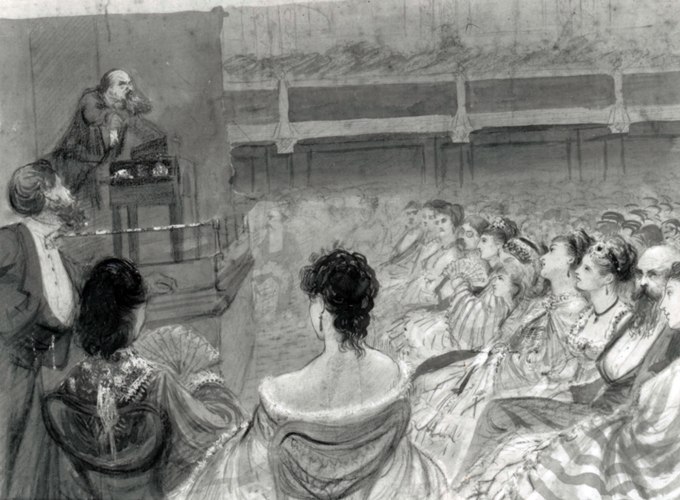
imageThe tour had been long and exhausting. Audiences were huge and everywhere ecstatic. The artist performed his usual greatest hits and was mobbed in the street outside the theatre. Profits were enormous and ticket touts had a field day. The performer found sleep impossible after the usual adrenaline rush and took to using sedatives. Who’s this, you might ask. Frank Sinatra in the 1950s? Mick Jagger in the 60s? Actually, no. This is Charles Dickens on his American Tour in 1857.
Dickens began his reading tours for the same reason rock stars do today. That’s where the money is. Nowadays top performers make more money from touring than making records. Dickens made nearly £20,000 from just one American tour. Estimates vary, depending on the basis of your calculation, but today this would be worth hundreds of thousands of pounds. He created a performance out of selections from his novels – the most popular scenes, such as Sykes’ murder of Nancy in Oliver Twist. If you think of his novels as albums, he did a medley of his most popular tracks. And, speaking again in musical terms, he re-arranged them, editing them to make them tighter and more powerful. Stagecraft was employed, as Dickens, like a singer, enacted the scenes with dramatic gestures. Mood changes were dynamic as he moved from quiet, poignant scenes to highly melodramatic ones. He filled 76 venues across America on that tour and repeated it several times in Britain.

image

(The caption should read “Dickens first reading tour for profit in Britain“)

No one else was in a position to do that, for the same reason large tours today only work financially for the most successful artists. Why? Because the performer needs a huge back catalogue of greatest hits. And Dickens certainly had that. And more importantly, he had always sold to the general public, including the less well-off. He sold his novels relatively cheaply, serialised weekly or monthly. His pop singles, if you like. He had a huge following, a fan base in today’s terms.
Dickens loved performing. He enjoyed the applause and adulation as much as any modern pop star. Some criticised him for demeaning his art. He didn’t quite become the type of prima donna we know today, famous for their backstage “riders”, precise dressing room requirements involving alcohol and entertainment. But Charles Dickens knew his worth and enjoyed life. On the American tour he established what he called his system. In his own words ” At 7 in the morning, in bed, a tumbler of new cream and two tablespoonful of rum. At 12, a sherry cobbler and a biscuit. At 3 (dinner time) a pint of champagne. At 5 minutes to 8, an egg beaten up with a glass of sherry.”
Way to go Charles!

Marcel Proust – Lost in Translation

imageFew people read Marcel Proust. When one of the most popular current means of communication limits utterances to 140 characters it is little wonder that a work containing a 30 page description of the author trying to get to sleep appears unattractive to modern tastes. There is another problem, however. There is a general misconception of the aim of his series of novels. This is due to the unhelpful mistranslation of the title of his work – in French, “À la recherche du temps perdu”. The weakest translation was the first one – “Remembrance of things past”, later updated to the generally accepted, but little better, “In search of lost time”. The problem is that these titles encourage the popular belief that Proust’s work is nostalgic, that it is primarily about the world of memory. This is confirmed in people’s minds by the importance placed by critics on the “Madeleine” scene, in which the taste of a Madeleine cake awakens in the author’s mind a vivid, involuntary childhood memory. In my experience people see this as the point of the book and their response is “So what?” This idea – that we recall the past through the senses of taste and smell – is commonplace. Is Proust famous because he wrote several volumes to show what we all know – that when we get into a new car the smell of the interior reminds us of our first car?
The problem has arisen partly because of the misleading translation of the word “perdu” in the title. The word can indeed be translated as “lost”, but it has the alternative meaning of “wasted”, which is closer to Proust’s intention. He is not simply showing us ways of recovering experiences which have been “lost” to our memory. He is showing us that we experience reality twice, once in life and then again in memory – and here’s the important bit – experience recovered by memory is more vivid and powerful. Why? – and this gets to the point of the importance of translating “perdu” as “wasted” – it is because we do not appreciate our lives fully the first time round. Memory doesn’t just revisit our lives, it salvages wasted experience. Alain de Botton, in his excellent book “How Proust can change your life”, sums up Proust’s intention as “How to love life today”.
In 1922 Proust wrote to a newspaper which had asked its readers what they would do if it was announced that the world was about to end. Proust asked why wait? We should always live our lives as if the world was about to end. He wrote ” I think that life would suddenly seem wonderful to us if we were threatened to die as you say.” Memory, particularly when prompted by the approach of old age, provides the same service. As Botton writes, Proust’s work ” far from a memoir tracing the passage of a more lyrical age, …. was a practical, universally applicable story about how to stop wasting, and begin appreciating one’s life”.