The “Where are they now” trope

F1FC5FAA-E608-49D0-88B1-3C9058FF5049

The end credits of the comedy film A Fish called Wanda include the final joke; we are informed that Kevin Kline’s evil character will go on to become minister for justice in South Africa. The writer John Cleese is making use of the now common “where are they now” trope popularised by George Lucas when he lists the fate of the characters at the end of American Graffiti.

The trope depends on irony. So I was not surprised to discover that the trope was employed by the master of irony, Gustave Flaubert. In a novel. More than 100 years before those two films.

Madame Bovary, published in 1856, has a kind of end credit. An ironic one intended to make us smile at, and despair over, the state of bourgeois France, represented by the ignorant, incompetent Monsieur Homais.

The final sentence translates as – “ He has just received the Legion of Honour”

The Sound of Silence

9C612A83-9AF4-47ED-AE62-C93125A8D199

By the end of the 1920s Charlie Chaplin was the most famous person in the world. His films were successful in every continent that had cinemas. He had complete control over the devising, directing and editing of his movies and was free to highlight his talent for mime. The essential ingredient of mime – the one that made his comedy so universally understandable – was, of course, silence. In 1928, however, the year Chaplin started work on his new film “City Lights”, there was a cloud on the horizon. The big success of the year before had been “The Jazz Singer” which demonstrated the popularity of a new technology – film sound. By 1929 8,000 cinemas had been wired for sound. Chaplin realised that this was a threat to his pre-eminence. What would the little tramp’s voice sound like? Chaplin himself had a strong cockney accent. Furthermore, sound would change the nature of film, particularly its pace. Chaplin’s films were masterpieces of rhythm and pace. Dialogue slows action down. How would Chaplin react?

Chaplin stuck to his guns and made “City Lights” into one of his greatest silent movies. It’s success seemed to vindicate Chaplin’s belief that film was essentially a silent medium. You would think  that “City Lights” would reinforce  Chaplin’s absolute self-belief. However, I think it is possible to interpret the film’s final scene as a demonstration of Chaplin’s growing doubts and fears.

In the film Chaplin’s tramp falls for a blind flower-girl and, colluding with a drunk millionaire, pretends that it is he who is her benefactor. In the final scene the tramp encounters her again and places a coin in her hand. She recognises him from this gesture. “You can see now” he asks. “Yes I can see now” she replies. The film ends with a look of terror on the tramp’s face. Will she still love me, now she sees me for the simple tramp that I am. What will she make of the way I look. It does not take a huge leap of imagination to see the girl as the cinema public and the tramp as Chaplin’s silent art form. “You can hear now?” Chaplin seems to be saying. “Yes, we can hear now” comes the reply. Will they still love me, Chaplin is thinking. Now that I do not have the rich trappings of the new technology. And if I did make a “talkie” what would they make of the way I sound. The film was a big success but in 1930 the jury was out. In the film we are left with the look of fear on Chaplin’s face.

Skiffle

In the summer of 1954 the popular music world was continuing in its usual easy listening way. Doris Day and Perry Como were riding high in the charts on both sides of the Atlantic. But, within a two-week period in July two events happened, one in Memphis, the other in London, that lit a fuse which a year later would blow that cosy music world sky high.
On the 5th July a certain unknown singer called Elvis Presley was larking about in Sam Phillips’ Sun recording studio in Memphis, jokily singing a Blues song, when Phillips recognised something he’d been looking for for years, a white guy who could sing black music without losing its sexual energy. Elvis was on his way. Within a matter of weeks, on the 13th July, the Chris Barber Jazz Band was recording an album in London when they realised they were short of material. Their banjo player, Lonnie Donegan, suggested they did some of the skiffle material they sometimes played. One of these songs was Rock Island Line. In 1955 it became the first British debut single to attain gold status and, as a result, skiffle spread throughout the UK. Skiffle was roots music played on cheap basic, sometimes home-made, instruments.
The two events were unconnected but had a combined effect. Young people in the UK saw Elvis as a far-off, unattainable dream. Skiffle gave them a means of at least striving for it. John Lennon in 1950s Liverpool, at the moment he heard Heartbreak Hotel, wanted to be Elvis. Now, with skiffle, he could do something about it. What he did was form the Quarrymen and use his skiffle band to play rock’nroll. And he wasnt the only one. Hundreds, probably thousands, of British teenagers did the same. At exactly the same time as Lennon formed his group I watched my two uncles, only five years older than me, rehearsing in Leeds with cheap acoustic guitars, tea-chest bass and washboard. They progressed to drums and electric guitars, as did Lennon and McCartney, in order to play Chuck Berry and Shadows music. They didn’t make the big time but they enjoyed the ride.
There was an ironic outcome to all this. Skiffle was always small fry compared to Elvis. It was rough, cheap and amateurish. But out of it came the 1960s British music invasion of the US, led by the Beatles, which swept all before it, including Elvis.
I saw it happen, without at first realising what was happening. I went from skiffle to rock’nroll to the Beatles. And I never shed a tear for Doris Day or Perry Como.

Rosebud

79E0D528-CB1B-4256-AB2F-3A72BB30EA0A

Orson Welles’ film “Citizen Kane” begins with Kane on his deathbed. As he expires he utters the word “rosebud”. It is only at the end of the film, after we have witnessed his ruthless rise to enormous wealth and power, that we find out that rosebud was the name of his favourite toy as a child, a simple wooden sledge. As he died, after a life of material success and glory, he chooses to think of a time of innocence and purity.
One evening in November 1787 a young French artillery officer, recently arrived from the provinces, decided to go to the galleries surrounding the Palais Royale in Paris. At that time the Palais Royale, in spite of its grand name, was an amalgam of contemporary shopping mall, amusement park and red light district. There, everything was for sale. The officer found what he was looking for, and escorted the young girl back to his lodgings. Afterwards he wrote about the evening in a notebook. What is clear from his words is that the event was more than a transaction. The young woman deeply impressed him. Less than 15 years later he became Emperor of France. He had 20 years of unparalleled fame, wealth and glory. When Napoleon Bonaparte died in 1821 the notebook was found among his belongings. Throughout his rise to power Bonaparte had kept and protected the account of his naive and nervous first sexual experience. The night at the Palais Royale was Napoleon’s “rosebud” moment. Is it going too far to speculate that had Welles made a film of Napoleon’s life, it would have started with him on his deathbed on St Helena uttering the words “Palais Royale”?

The Literary Dolly Zoom

Films and books have different qualities and different purposes. Sometimes however, with certain authors, books can compete with films on the same terms. Cormac McCarthy’s style, for example, can be described as cinematic. There is a passage in chapter 4 of “Blood Meridian” which is quite simply breathtaking. It describes a massacre. It is filmic in the way it portrays the event from the victims’ point of view. It starts with what in a film would be called a long shot:- “The following day on the skyline to the south they saw clouds of dust that lay across the earth for miles.” The troop of soldiers watch a herd of cattle and horses approach, unconcerned. You can imagine the film soundtrack as the herd speeds up and becomes noisier, a little more threatening:- “The ponies had begun to veer off from the herd and the drovers were beating their way toward this armed company” There then follows what I can only describe as the most astounding sentence I have ever read. It is about 250 words long. The sentence doesn’t just describe the Indian charge but replicates it. The words themselves stampede forward. As a reader you hold your breath and feel the horror of the transfixed victims:- “A legion of horribles, hundreds in number, half naked or clad in costumes attic or biblical or wardrobed out of a fevered dream with the skins of animals and silk finery and pieces of uniform still tracked with the blood of former owners ….. one in a stovepipe hat and one with an umbrella and one in white stockings and a bloodstained weddingveil …. all howling in a barborous tongue and riding down on them like a horde from hell”. The camera is now in amongst the riders. Suddenly we get a close-up of the sergeant’s face, represented by one short sentence, as he realises his fate:- “Oh my god, said the sergeant.” 6 words. It’s as if the 250 word charge has come to a juddering stop. 6 words that seem as powerless as the soldiers facing the horde of riders. A great example of style matching content.

The whole two-page “tour de force” reminds me of the beach scene in Jaws, when the shark attacks. Here also the threat builds slowly through the use of the famous soundtrack, from long shot of the beach, through closer shots of the swimmers to the close-up of the police chief’s face as he realises the seriousness of the danger. The same psychological impact is achieved in both book and film. In Jaws the technique used is the dolly zoom shot, in which the camera moves in at a speed synchronised with the lens zooming out. The result is that the background telescopes away from the camera and the effect suggests the sudden psychological disorientation of the subject. In the book, the sudden short sentence zooms in on the victim’s face in a similar way. Those six words are in effect a literary dolly zoom shot. Even before the Indians reach their victims, McCarthy’s book has generated as much tension and drama as any film.

A dog and a toilet*

image

My school had a film club. Early 1960s so it involved a 35mm reel-to-reel projector, which meant the film had to be rewound at the end to be ready for the next showing. One time, when the lights dimmed we found ourselves watching Tom Courtney running backwards down a country lane. At a stroke, by forgetting to rewind the film, our teacher had transformed “The Loneliness of the Long Distance Runner” into a Surrealist film.

The Surrealists had a variety of ways of removing rationality from the experience of viewing a film. Sometimes – perhaps when the recreational drugs had run out – they would spend the evening in Paris running from cinema to cinema watching random snatches of several different films – the film equivalent of Chinese Whispers. To randomise the experience even more they would wave their hands in front of their eyes as they watched.

I’ve always thought the Surrealists could have saved themselves a lot of effort by joining my school’s film club.

* ( A dog and a toilet? That was how my friend referred to Luis Buñuel’s Surrealist masterpiece “Un chien Andalou” )

Gregor the Graduate

Two scenes, over 50 years apart, one from a novel, the other from a film, have always struck a chord with me.

In 1915 Franz Kafka published “Metamorphosis” which opens with Gregor Samsa waking up to find he has changed into some kind of beetle or cockroach. He still feels like Gregor Samsa but is trapped inside an exoskeleton – a hard outer shell from within which he looks out at the threatening world ruled by his father.

Mike Nichols’ film “The Graduate”, released in 1969, contains a scene in which Benjamin Braddock, played by Dustin Hoffman, is presented at his graduation party wearing the all-encasing diving-suit and goggles his parents have given him as a present. We have already become aware of Benjamin’s anxiety about the teenage pressures of girls, family and future prospects. Nichols takes us inside the wetsuit and we hear Benjamin’s laboured breathing and feel the claustrophobic smothering of the suit as we look out through the goggles at the demanding, threatening world of adults.

I think these scenes are more than metaphors for alienation. I believe they represent felt experience, the explanation for which can be found in psychology.

In 1960 the psychologist R.D. Laing published “The Divided Self” in which he refers to the schizoid anxieties of psychologically insecure people. He identified a condition known as “engulfment” in which the individual feels he is being buried or drowned by the world around him. Such a person commonly dreads turning from a living being to a dead thing, an automaton, a robot. To come to terms with these feelings he seeks isolation, withdraws within a shell, and comes to feel as if his real self is trapped within an alien body, and this self looks out from within a fixed exterior which serves as a shield against a threatening outside world.

Both Gregor and Benjamin are suffering from anxiety and in particular from engulfment. There is a difference in the degree of this anxiety represented by the form of their outer shells. Benjamin’s wetsuit is restricting and uncomfortable – comic even. Gregor’s insect exoskeleton, however, evinces a dreadful fear and disgust. There is a world of difference between the uncomfortable squirming felt by Benjamin Braddock and the anguish and dread felt by Gregor, but they belong to the same condition. Laing tells us that psychosis is a continuum. On a scale of 1 to 10 Benjamin is at 2 and Gregor at 9.

In “The Graduate” Dustin Hoffman’s acting style was a perfect fit. It is the same mechanical, “rabbit-in-the-headlights” style he used later to good effect as the autistic brother in “Rainman”.There is an early shot of him in “The Graduate” gliding on a moving walkway, staring ahead, rigid and robot-like. Hoffman was a proponent of “method” acting, which involves drawing on personal experience to lend authenticity to the emotions being portrayed. What experience was he drawing on when he played Benjamin Braddock?

Engulfment is not just a theory. It exists. I know it exists because I have experienced it myself. There was a time when I felt that the physical thing seen by other people was not me but a false outer shell being operated from within by a hidden real me. It is common for people to put on a false front behind which they can hide their real feelings. This was different, though. Engulfment led me to experience my two selves as a physical reality. I had an exoskeleton. For a time I was Gregor the Graduate.

The Albatross

chatterton

 Ce voyageur ailé, comme il est gauche et veule          

Lui, naguere si beau, qu’il est comique et laid .

 Exilé sur le sol au milieu des huées,                                                                                                                                  

Ses ailes de géant l’empeche de marcher  

 (How ungainly and contemptible the winged traveller becomes    

How laughable and graceless, he who only a moment ago was so full of beauty

Exiled on earth, an object of scorn,

His giant wings impede him as he walks)                                                                                            

 L’Albatros Charles Baudelaire  Les Fleurs du Mal   first publ. 1857

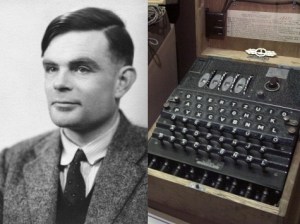
Alan Turing, gifted mathematician and inventor of a prototype computer, was instrumental in breaking the German Enigma code during the Second World War. It is believed his work at Bletchley Park shortened the war by at least two years. After the war his work went unrecognised because of the Official Secrets Act. Turing was homosexual, was pursued by the police, convicted of gross indecency in 1952 and was given the choice of a prison sentence or chemical castration. He chose the latter. He committed suicide two years later.

Yesterday I saw the film “The Imitation Game” which tells his story. It’s a moving film – how could it fail to be – and Benedict Cumberbatch gives a powerful performance as Turing. Some critics have noted the formulaic nature of the film.One stated ” Somehow …with its cookie-cutter screen-writing and lacquered, nominate-me-for-everything sheen, (it) manages to feel like a series of stories we’ve heard before, following the familiar contours of other films.” I agree , but what is not made clear is where the formula comes from and why it falls short.

The formula has its roots in literary history. The story of the tragic genius is part of the Romantic tradition. The trajectory of this story is familiar because it has remained unchanged for nearly 200 years. In this tradition the Genius inhabits a world set apart from mere mortals and in achieving greatness suffers ridicule and rejection from the common crowd. This is a fate incumbent on him. Several times in the film Turing is told “no normal person could do such great things”  to help him accept his suffering.We see him bullied and beaten at school for his cleverness. We are shown that his success in his work is a direct result of his awkwardness in the company of others and the resulting isolation.

The Romantic tradition grew out of a fundamental shift in thought, a new belief in the authenticity and primacy of an individual’s  view of the world and the uniqueness of each person’s feelings. The artist/genius was seen as a special case, someone who leads the way in this new belief, someone who is prepared, martyr-like, to expose his feelings to the public, so risking ridicule and scorn.It is hard now to appreciate the impact of this new expressive art, since it is what we have come to expect. The impact was enormous. Jean-Jacques Rousseau published one of the first Romantic novels, “La Nouvelle Héloise” , in 1761. Its forefronting of a painful emotional life caused a sensation. By the end of the century it had gone through more than 70 editions. Rousseau became famous and was inundated with fan mail. Tragic Romantic heroes became fashionable from then on. In 1774 Goethe published “The sufferings of Young Werther” in which a man’s frustrated passion drives him to suicide. The ultimate artist-as-suffering-hero at the beginning of the 19th century was Beethoven. He once wrote that only his art, and the need to express everything inside him, had prevented him from taking his own life. He became a legend in his own lifetime as much for his personal image as for his music, due to the knowledge the public had of his deafness and his solitary and withdrawn life.

Eventually, as in “The Imitation Game”, artists’ lives began to be re-evaluated in light of the new Romantic tradition. So the poet Thomas Chatterton, pictured at the head of this piece, who had taken his own life at the age of 17 in 1770, was rediscovered by the Romantics at the beginning of the 19th century. John Keats wrote an Ode in which Chatterton, like Turing, is seen through the prism of Romanticism:-

  “O Chatterton! how very sad thy fate.  Dear child of sorrow – son of misery!                                                                              How soon the film of death obscured that eye, Whence Genius mildly flash’d, and high debate”  

We still live in the Romantic era. That’s why films can appropriate Romantic ideas. In fact we believe more and more in the primacy of the individual. In our self-obsessed, media-driven technologically advanced times, confident and sure of our modernity, it is perhaps surprising to read the opening lines of Rousseau’s “Confessions” of 1782 which set us off down the Romantic path:-

“I have resolved on an enterprise which has no precedent, and which, once complete, will have no imitator. My purpose is to display to my kind a portrait in every way true to nature, and the man I shall portray will be myself. Simply myself. I know my own heart and understand my fellow man. But I am made unlike any one I have ever met; I will even venture to say that I am like no one in the whole world. I may be no better, but at least I am different.”

Revolutionary then, now simply the assumption driving social media.

The problem with The Imitation Game”, as I see it, is that it puts dialogue inspired by the Romantic tradition into a contemporary setting. The Romantic tradition has not dated as much as Romantic language has. In the film this language is not fit for purpose and so some of the dialogue sounds, for want of a better word, clunky.

Poetry does it better. If you want a fitting memorial to Alan Turing you could do worse than read Charles Baudelaire’s “The Albatross”, quoted at the head of this blog. Romantic thought is better suited to metaphor, to abstract, transcendental truth. You don’t need to write about Alan Turing to express the tragedy of his life. A metaphor which stands for all such lives is powerful enough. Baudelaire, although normally seen as a precursor to symbolist and modernist art, had his roots in the Romantic tradition. In his poem, the fate of the albatross is compared to that of the poet/genius. In the air the graceful bird wanders as free as the poet’s imagination. When caught by sailors and trapped on board ship it staggers clumsily and is subject to the sailors’ mockery. And here is the point – explaining the poem, or translating it, as I did at the start of this piece, makes the same mistake as the film. The metaphor is enough. It carries the poem and its meaning by itself. It is moving without the need for explanation.That’s what poetry does – it moves us without recourse to clumsy literalness. Indeed, poetry is the albatross. Left to soar and roam in the imagination it is a thing of beauty. Brought down to earth by explanation it limps and stumbles. Furthermore, because of the nature of the industry, a film can be like an albatross designed by committee. It may be composed of many admirable working parts, but it doesn’t get off the ground. It is too heavy to fly.
Alan_Turing_Machine     fleursdumal