Biff and Oscar Wilde’s Lost Sock

4D88F6D3-EF61-4D5F-9ED4-0D76D2B980BE

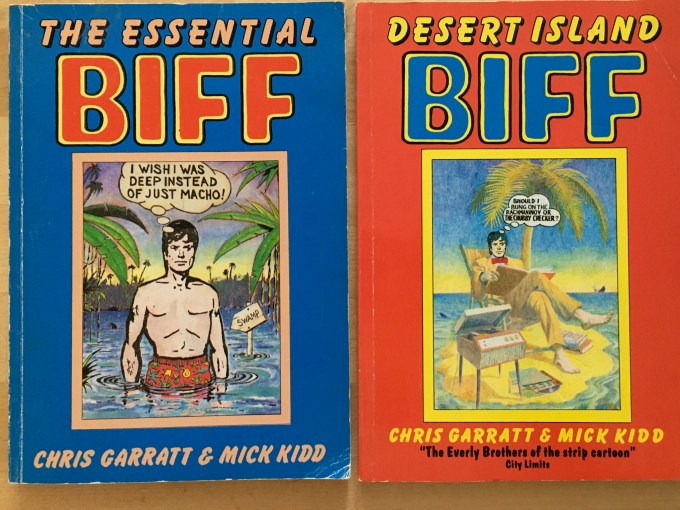
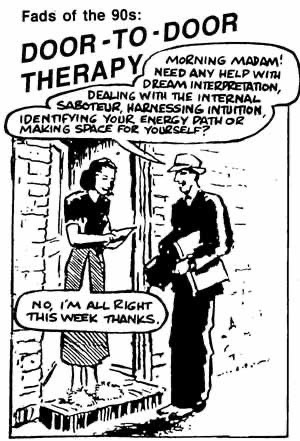
Biff is a British cartoon strip created by Chris Garrett and Mick Kidd in the 1980s. Its humour deflates pretentiousness by placing it in an everyday setting. Melodramatic, self-regarding, would-be poets are brought down to earth by ordinary people. Or pompous language is deflated by a non-sequitur

FC211546-FD73-4718-8F45-47530EC2326B

The cartoons are funny but they have a ring of truth. When I read them I know I’m laughing at myself. Oscar Wilde would have appreciated them. He tells a story of once going down to the Seine and, in true Romantic poet style, thinking of jumping in. On a bridge he saw another man looking down into the river. “Are you also a candidate for suicide?” Wilde asked. “No, I’m a hairdresser” came the reply. The comical non- sequitur so cheered Wilde up that he changed his mind.

In one cartoon a 1950s style teenager despairs with the words “I feel like a lost sock in the laundromat of oblivion”. With my slight adjustment to the boys name his girlfriend asks “Is it Angst, Oscar. Or is it just the lager?”


Irony and Ideology

98325CA0-A5C4-4A35-97DB-B438429AEEAC

Do ideologues understand irony? I doubt it. Not the verbal kind at least. When the words you use express the opposite of the literal meaning. People of conviction don’t mince their words. That’s why you should mistrust ideologues. People who don’t question themselves are blinkered and dangerous.

When Austria became part of the Third Reich in 1938 Sigmund Freud knew it was time to leave Vienna. Himmler was minded not to let him go to America but President Roosevelt arranged for him to get the necessary visa. When the Gestapo delivered it they asked him to sign a document to confirm he had been well treated. Freud did sign but added a sentence – “I can heartily recommend the Gestapo to anyone”. This was taken at face value. I like to imagine the Gestapo officers smugly leaving with the apparently glowing recommendation.

German scientists during WW2 were among the best in the world. They  designed the first jet fighter planes, the first guided missiles and came close to producing the first atomic bomb. But they never developed an irony detector.

False Friends

C472F790-B2F2-4EF7-A5CE-371E73C3B401

When you start learning French you are always warned about “faux amis”, false friends. Words that look as if they have an obvious meaning but which mean something quite different. So “assister” means to attend, not to help. A teaching colleague of mine, an elderly and unworldly spinster, was unaware that the word “préservatif” was a false friend. Her 6th form students knew that it was French for “condom”, so they enjoyed the lesson in which the word featured and their teacher proceeded to try and explain why the couple in the story they were translating might be in need of jam.

The interesting thing is that a false friend can change the meaning of a phrase. “Ancien” in French means “previous” not “ancient” but this has not prevented the term ”ancien régime”, the political system toppled by the French Revolution, from being wrongly associated in many minds with the words “ancient” or “archaic”. In fact the term was first used in 1790 by the Comte de Mirabeau in a letter to the King. He was simply referring to the previous regime.

So what? Well it can lead to misunderstanding. It is generally believed that the French Revolution came about because the political system was old, out of date and crumbling. This has been partly encouraged by the false friend “ancien régime”. In actual fact it can be argued, as indeed it is in Simon Sharma’s brilliant book Citizens, that the regime collapsed because of the bungled way in which it was trying to modernise in the 1780s.

A similar process seems to operate in the case of the English phrase “the Dark Ages”. The phrase was coined to describe the era in which only limited written evidence has come down to us. The age is dark because little light is shed on it. However, the word “dark” operates as a false friend because it can be associated with words such as sinister, dangerous, savage, uncivilised. And this hides the fact that the limited evidence we have from medieval times points to the existence of poetry, refinement and craftsmanship.

We are well aware of the dangers of false news. We should also recognise that false news is sometimes brought by false friends.