
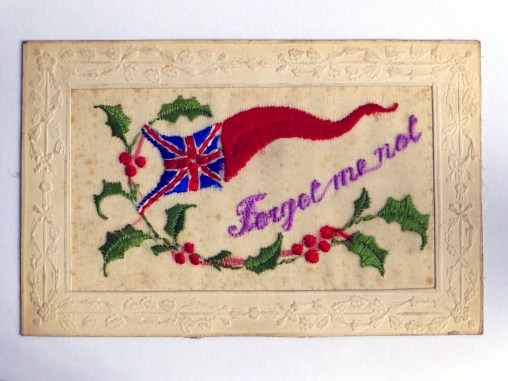
 About 20 years ago dad gave me a photo album. It was full of postcards collected by his mother Mary Ellen. These postcards are now just over 100 years old. Some had been sent by her brother from France during the 1st World War. They helped me get a picture of a side of the family I know little about, because dad hardly ever talked about it. But it’s more than that; it’s a social history too.
 Mary Ellen was of Irish decent like many living in Leeds. She was born Mary Ellen Quinn in 1897. She lived most of her adult life on Halton Moor Avenue but in 1914 her home was in Jack Lane in the centre of Leeds. The postcards are from her brother from the trenches in France. Not all of them were sent to her but I find it interesting that she saved them and made a collection from them. It’s not always obvious that ordinary stuff will one day be of interest. The cards show what people – soldiers and the general public – thought the war was going to be like – stirring cavalry charges, glory and honour. As we now know it was far from that. The soldiers discovered this to their cost. The general public never did. Because of the propaganda of postcards such as this the truth was hidden from them. So there was a split between those who went to war and those who didn’t. And the split was never healed because the returning soldiers wouldn’t, or couldn’t, talk about it. Why? Well think what it’s like trying to tell others that your pain is worse than theirs. They tend not to believe you, or they suspect you of being a martyr. So you keep quiet.
The cards show what people – soldiers and the general public – thought the war was going to be like – stirring cavalry charges, glory and honour. As we now know it was far from that. The soldiers discovered this to their cost. The general public never did. Because of the propaganda of postcards such as this the truth was hidden from them. So there was a split between those who went to war and those who didn’t. And the split was never healed because the returning soldiers wouldn’t, or couldn’t, talk about it. Why? Well think what it’s like trying to tell others that your pain is worse than theirs. They tend not to believe you, or they suspect you of being a martyr. So you keep quiet. What I want to say is that this had an effect on my family. One of the soldiers in the war was Clifford Wells. He was invalided out of the war after being gassed. When he returned he met Mary Ellen. They married and my dad Dennis was born in 1923. My dad never got on with his father and so never talked about him to me. In fact I only found out his first name about 5 years ago. Clifford had a bad reputation. Dad called him a waster and said “he thought the world owed him a living”. I have no way of knowing how badly treated my dad was, but I think he was telling the truth. Dad had a tough life. It wasn’t easy living through the 1920s and 30s. All I am saying, in part defence of Clifford, is that both he and my dad were casualties of war. They embody the split between those who were there and those who weren’t. Dad couldn’t understand where Clifford was coming from. I’m pleading mitigating circumstances. The irony is my dad did his bit in the Second World War,
met mam when he was demobbed, married and I was born in 1948. History repeating itself. And in more ways than one. I didn’t get on well with dad. We didn’t talk enough. That’s why the Mary Ellen and Clifford story means so much to me.
My birthday falls on the 1st July. This year that date marks the 100th anniversary of the first day of the battle of the Somme, the most disastrous day in British military history. British forces were told to march slowly in tight formation towards hundreds of German machine guns. They did. There were 60,000 casualties; a third of those died. I don’t know if Clifford was there but it is likely he was. If so, we his descendants are very lucky. Because of the 1st of July 1916, 20,000 future British families never came into existence. The only charity event I regularly support is Poppy Day.
Mary Ellen died in 1957 aged 60 and is buried in Harehills Cemetery in Leeds. All I can tell you about Clifford’s later years is that he was still alive when I was born
 my chautauqua