

Ce voyageur ailé, comme il est gauche et veule
Lui, naguere si beau, qu’il est comique et laid .
Exilé sur le sol au milieu des huées,
Ses ailes de géant l’empeche de marcher
(How ungainly and contemptible the winged traveller becomes
How laughable and graceless, he who only a moment ago was so full of beauty
Exiled on earth, an object of scorn,
His giant wings impede him as he walks)
L’Albatros Charles Baudelaire Les Fleurs du Mal first publ. 1857
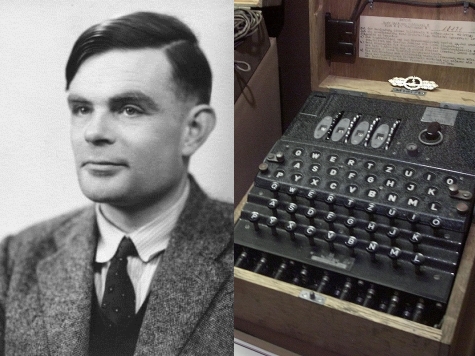
Alan Turing, gifted mathematician and inventor of a prototype computer, was instrumental in breaking the German Enigma code during the Second World War. It is believed his work at Bletchley Park shortened the war by at least two years. After the war his work went unrecognised because of the Official Secrets Act. Turing was homosexual, was pursued by the police, convicted of gross indecency in 1952 and was given the choice of a prison sentence or chemical castration. He chose the latter. He committed suicide two years later.
Yesterday I saw the film “The Imitation Game” which tells his story. It’s a moving film – how could it fail to be – and Benedict Cumberbatch gives a powerful performance as Turing. Some critics have noted the formulaic nature of the film.One stated ” Somehow …with its cookie-cutter screen-writing and lacquered, nominate-me-for-everything sheen, (it) manages to feel like a series of stories we’ve heard before, following the familiar contours of other films.” I agree , but what is not made clear is where the formula comes from and why it falls short.
The formula has its roots in literary history. The story of the tragic genius is part of the Romantic tradition. The trajectory of this story is familiar because it has remained unchanged for nearly 200 years. In this tradition the Genius inhabits a world set apart from mere mortals and in achieving greatness suffers ridicule and rejection from the common crowd. This is a fate incumbent on him. Several times in the film Turing is told “no normal person could do such great things” to help him accept his suffering.We see him bullied and beaten at school for his cleverness. We are shown that his success in his work is a direct result of his awkwardness in the company of others and the resulting isolation.
The Romantic tradition grew out of a fundamental shift in thought, a new belief in the authenticity and primacy of an individual’s view of the world and the uniqueness of each person’s feelings. The artist/genius was seen as a special case, someone who leads the way in this new belief, someone who is prepared, martyr-like, to expose his feelings to the public, so risking ridicule and scorn.It is hard now to appreciate the impact of this new expressive art, since it is what we have come to expect. The impact was enormous. Jean-Jacques Rousseau published one of the first Romantic novels, “La Nouvelle Héloise” , in 1761. Its forefronting of a painful emotional life caused a sensation. By the end of the century it had gone through more than 70 editions. Rousseau became famous and was inundated with fan mail. Tragic Romantic heroes became fashionable from then on. In 1774 Goethe published “The sufferings of Young Werther” in which a man’s frustrated passion drives him to suicide. The ultimate artist-as-suffering-hero at the beginning of the 19th century was Beethoven. He once wrote that only his art, and the need to express everything inside him, had prevented him from taking his own life. He became a legend in his own lifetime as much for his personal image as for his music, due to the knowledge the public had of his deafness and his solitary and withdrawn life.
Eventually, as in “The Imitation Game”, artists’ lives began to be re-evaluated in light of the new Romantic tradition. So the poet Thomas Chatterton, pictured at the head of this piece, who had taken his own life at the age of 17 in 1770, was rediscovered by the Romantics at the beginning of the 19th century. John Keats wrote an Ode in which Chatterton, like Turing, is seen through the prism of Romanticism:-
“O Chatterton! how very sad thy fate. Dear child of sorrow – son of misery! How soon the film of death obscured that eye, Whence Genius mildly flash’d, and high debate”
We still live in the Romantic era. That’s why films can appropriate Romantic ideas. In fact we believe more and more in the primacy of the individual. In our self-obsessed, media-driven technologically advanced times, confident and sure of our modernity, it is perhaps surprising to read the opening lines of Rousseau’s “Confessions” of 1782 which set us off down the Romantic path:-
“I have resolved on an enterprise which has no precedent, and which, once complete, will have no imitator. My purpose is to display to my kind a portrait in every way true to nature, and the man I shall portray will be myself. Simply myself. I know my own heart and understand my fellow man. But I am made unlike any one I have ever met; I will even venture to say that I am like no one in the whole world. I may be no better, but at least I am different.”
Revolutionary then, now simply the assumption driving social media.
The problem with The Imitation Game”, as I see it, is that it puts dialogue inspired by the Romantic tradition into a contemporary setting. The Romantic tradition has not dated as much as Romantic language has. In the film this language is not fit for purpose and so some of the dialogue sounds, for want of a better word, clunky.
Poetry does it better. If you want a fitting memorial to Alan Turing you could do worse than read Charles Baudelaire’s “The Albatross”, quoted at the head of this blog. Romantic thought is better suited to metaphor, to abstract, transcendental truth. You don’t need to write about Alan Turing to express the tragedy of his life. A metaphor which stands for all such lives is powerful enough. Baudelaire, although normally seen as a precursor to symbolist and modernist art, had his roots in the Romantic tradition. In his poem, the fate of the albatross is compared to that of the poet/genius. In the air the graceful bird wanders as free as the poet’s imagination. When caught by sailors and trapped on board ship it staggers clumsily and is subject to the sailors’ mockery. And here is the point – explaining the poem, or translating it, as I did at the start of this piece, makes the same mistake as the film. The metaphor is enough. It carries the poem and its meaning by itself. It is moving without the need for explanation.That’s what poetry does – it moves us without recourse to clumsy literalness. Indeed, poetry is the albatross. Left to soar and roam in the imagination it is a thing of beauty. Brought down to earth by explanation it limps and stumbles. Furthermore, because of the nature of the industry, a film can be like an albatross designed by committee. It may be composed of many admirable working parts, but it doesn’t get off the ground. It is too heavy to fly.

 my chautauqua